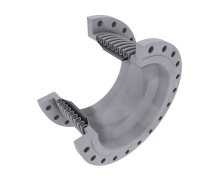
Metallic Expansion Compensators
Metallic Expansion Compensators
Introduction:
Metallic Expansion Compensators are designed to compensate for thermal growth, equipment movement, vibration or pressure pulsation within a piping system whilst containing pressure and the medium running through it.
Metallic Expansion Compensators are designed to accommodate movement in the three axis:
Axial Movement
Change in dimensional length of the compensator from its free length in a direction parallel to its longitudinal axis.
Lateral Movement
Displacement of one end of the compensator to the other, in a direction perpendicular to the longitudinal axis.
Angular Movement
Rotational displacement of the longitudinal axis of the compensator toward a point of rotation.
Metallic Expansion Joint Advantages:
- Little space required for installation.
- Absorption of movements in multiple directions due to their inherent flexibility.
- They require no maintenance.
- They reduce load and temperature loss to a minimum.
| Available Configurations | Application (Typical) |
| Weld Ends | Axial Movements |
| Fixed Flanges | Axial Movements |
| Floating Flanges | Axial Movements |
| Reinforcement Rings | High Pressure Systems |
| Single Convolution | Heat Exchangers |
| Tie Rods | To limit over extension |
| Threaded | Internal or External |
| Jacketed | For Insulation |
Materials Of Construction:
Metallic Expansion Joints are available in a variety of materials depending upon the specific application and associated operating conditions. Consideration must be given to:
- Temperature resistance
- Corrosion resistance
- Mechanical characteristics
- Resistance to fatigue
- Flexibility required
Both Circular and Rectangular geometries are available in the following materials choices:
Stainless Steel grades including:
- 304 Stainless Steel
- 304L
- 316
- 316L
- 321
Exotic Inconel and Hastelloy versions are also available.